
Blog
- Home
- Blog
Why Traditional CBT May Not Be Enough for OCD
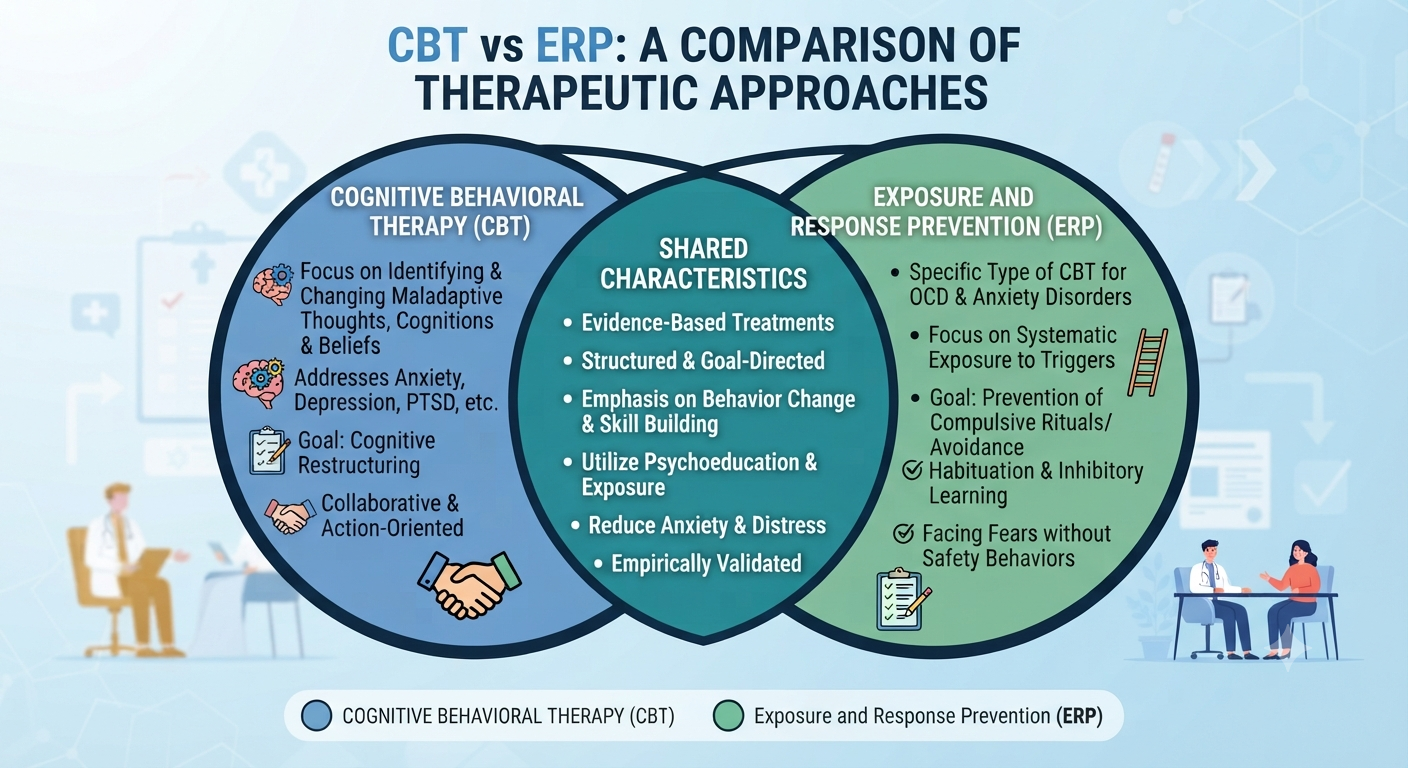
There is a common misunderstanding about OCD.
"If CBT works for anxiety and depression, why shouldn't it work for OCD in exactly the same way?"
The answer lies in understanding what OCD is actually asking for.
CBT, or Cognitive Behavioural Therapy, developed as a formal psychological approach during the 1960s and became highly influential in treating problems involving unhelpful patterns of thinking.
And it can be very useful for conditions such as anxiety and depression.
For example, imagine a student with exam anxiety thinking:
"I am definitely going to fail tomorrow."
Here, we can examine the thought.
Are you predicting the future?
Do you actually know that you will fail?
Are you focusing only on the negative possibility?
The person may realise:
"I don't actually know whether I will pass or fail. I can prepare and deal with whatever happens."
This kind of cognitive restructuring can be very helpful.
But OCD can work differently.
Someone with OCD may have a thought like:
"What if I secretly wanted to hurt someone?"
If we immediately try to prove the thought wrong, the person may feel relieved.
"You don't actually want to hurt anyone."
"You're a good person."
But then OCD asks:
"But how do you know?"
And the cycle starts again.
More analysis, more checking, more mental reviewing, more reassurance.
Intolerance of Uncertainty
This is where one of the most important processes in OCD becomes relevant: intolerance of uncertainty.
The problem isn't always the irrational thought itself.
Sometimes the bigger problem is the inability to tolerate not knowing.
In exam anxiety, challenging "I will definitely fail" can be helpful because the person is making a prediction about the future.
But in OCD, trying to replace:
"Maybe I did something wrong."
with:
"I definitely didn't."
can become another form of reassurance.
The brain learns:
"Whenever uncertainty appears, I need to solve it."
And that can keep the OCD cycle going.
Why ERP Became Important
This is one of the reasons Exposure and Response Prevention, or ERP, became so important in OCD treatment.
ERP emerged from behavioural treatment approaches during the 1960s and 1970s and was developed and refined specifically for OCD.
Instead of continuously trying to prove that the feared outcome is impossible, ERP gradually helps a person experience the feared thought, situation, sensation or uncertainty without performing the compulsion.
The response becomes:
"Maybe I did. Maybe I didn't."
"I don't need to know with 100% certainty."
This doesn't mean accepting that the feared event actually happened.
It means learning that uncertainty does not automatically require a response.
CBT Is Not "Bad" for OCD
ERP itself grew from the broader behavioural and cognitive-behavioural tradition.
The point is that OCD requires these principles to be applied differently.
Cognitive distortions are still important to understand:
Catastrophizing.
Black-and-white thinking.
Thought-action fusion.
Overestimation of threat.
And especially:
Intolerance of uncertainty.
But identifying a cognitive distortion doesn't always mean arguing with the thought until you finally feel certain.
Sometimes, repeatedly challenging the thought can itself become part of the OCD cycle.
The person may become very good at analysing their thoughts but still remain trapped in OCD.
That is why OCD treatment needs to look beyond the content of the thought and understand what happens after the thought appears.
Do you check?
Do you avoid?
Do you seek reassurance?
Do you mentally review what happened?
Do you try to get 100% certainty?
These responses can become part of what keeps OCD going.
ERP approaches this cycle differently.
Instead of teaching the brain:
"I need to prove that this thought is false."
it gradually teaches:
"I can experience uncertainty without performing a compulsion."
And sometimes recovery is not about finding the perfect answer to every "What if?"
It is about learning that you don't need one.
Coach, Kartikey
Founder of Voice at Peace
Recent Posts
-

How to Identify Subtle Compulsions
Jan 01, 1970 -
-

-

A Small Tip to Stop Arguing With Your OCD Thoughts
Jan 01, 1970 -

Why “Why Did I Get OCD?” Doesn’t Matter in Recovery
Jan 01, 1970